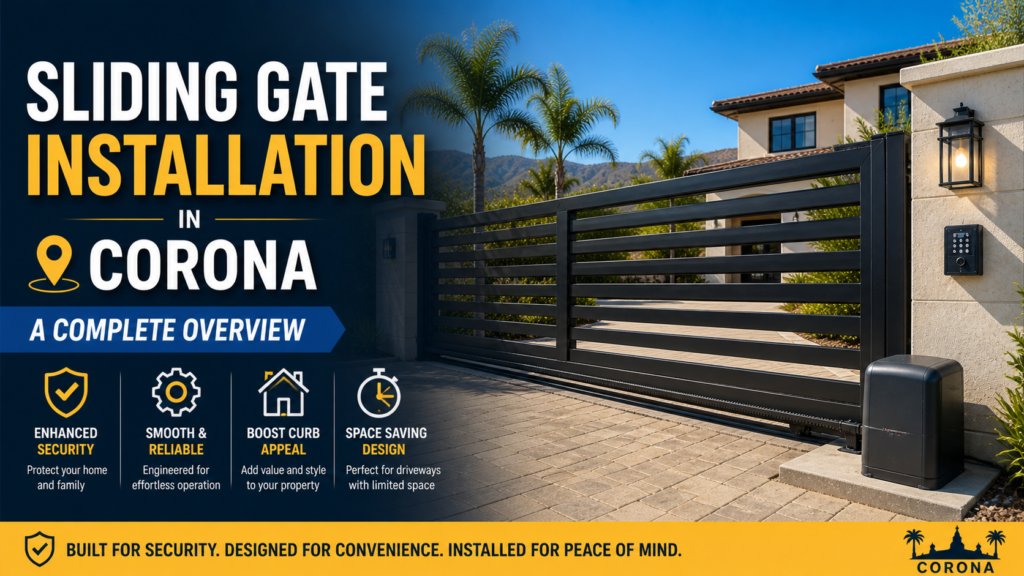
Among the various types of driveway gates available to property owners, the sliding gate stands out for its space efficiency, mechanical reliability, and modern aesthetic. In Corona, California where property layouts vary widely between established residential neighbourhoods and newer subdivisions, Sliding Gate Installation Corona has become an increasingly popular solution for homeowners and businesses seeking controlled access without the space demands of a traditional swing gate.
How a Sliding Gate Works
A sliding gate operates by moving horizontally along a track or cantilever system, parallel to the fence or wall beside the driveway. Rather than swinging open on a hinge, the gate panel slides to one side, clearing the driveway opening without projecting outward or inward into the property.
In a standard track-based system, a rail or channel is embedded in or mounted on the driveway surface, and the gate panel rides along this track on rollers or wheels. The track must be precisely level across the width of the driveway for the gate to slide smoothly. In cantilever systems, the gate is suspended from rollers mounted on sturdy posts, with no ground track required. This is a particularly useful configuration for driveways with uneven surfaces or areas that experience drainage issues.
Types of Sliding Gates
Sliding gates come in several configurations, each suited to different property types and access needs.
- Single-Panel Sliding Gates: The most common residential configuration, where a single gate panel slides to one side to open. The fence line or wall on the open side must provide enough space for the full gate panel to retract typically 150 percent of the driveway width to ensure complete clearance.
- Bi-Parting Sliding Gates: Two panels that slide open from the centre in opposite directions. This configuration requires less lateral space on each side and is well-suited for wide entrances, commercial properties, or situations where the space for a full single-panel retraction is unavailable on one side.
- Cantilever Sliding Gates: As mentioned, these are supported from above by a cantilever frame rather than resting on a ground track. They are the preferred choice where ground tracks would be problematic, such as on sloped driveways or surfaces that would make track maintenance difficult.
- Telescoping Sliding Gates: Used for very wide openings where a standard single-panel gate would require an impractically large retraction space. Multiple panels nest together as they slide open, reducing the space needed on the retraction side.
Advantages of Sliding Gates
Sliding gates offer a distinct set of benefits that make them the preferred choice in many scenarios.
Space Efficiency: The most significant advantage is that a sliding gate requires no clearance arc. Unlike swing gates, which need open space to pivot inward or outward, a sliding gate moves only laterally. This makes it ideal for properties where a vehicle might park close to the gate, for driveways on steep inclines, or for urban and suburban lots with limited depth.
Structural Security: Sliding gates are generally considered more resistant to forced entry than swing gates. A swing gate can potentially be forced open by applying pressure to the end furthest from the hinge. A sliding gate, by contrast, locks into position along a track or drop bolt system, making it much more difficult to force by lateral pressure.
Wind Resistance: Because they are supported along their full horizontal length rather than cantilevering on hinge points, sliding gates tend to handle wind loading more effectively. This is relevant in areas of Southern California that experience strong Santa Ana winds.
Durability: With heavy-duty rollers, a well-anchored track system, and quality materials, a sliding gate can sustain consistent daily use for many years with minimal mechanical stress on individual components.
Automation Compatibility: Sliding gates integrate very well with automated operators. The linear movement of the gate lends itself naturally to chain-drive or rack-and-pinion operators, and the installation of access control systems keypads, intercoms, loop detectors is straightforward.
Material Options
Sliding gates can be fabricated from several materials, each with its own character and maintenance profile.
Steel is the most common choice for strength and affordability. It can be powder-coated in a wide range of colours and finishes for weather protection. Wrought iron offers a classic, ornamental appearance and exceptional durability, though it is heavier and requires periodic maintenance to prevent corrosion. Aluminium provides a lightweight alternative that is naturally resistant to rust, making it a practical choice for coastal or humid environments. Wood sliding gates offer a warm, natural appearance but must be engineered carefully to handle the weight of sliding operation without warping or sagging over time.
Site Requirements for Installation
Before a sliding gate can be installed, the site must meet certain physical requirements. The driveway surface must be level from left to right (no cross-slope) so the track and rollers function without the gate binding or drifting. The ground or foundation where the posts will be anchored must be solid and capable of supporting the gate’s weight, particularly for cantilever systems where all load is borne by the support posts. The fence or wall beside the driveway must provide adequate space for the gate panel to retract fully. And if automation is planned, a power supply must be accessible at the operator mounting location.
The Installation Process
A professional sliding gate installation begins with a detailed site measurement and assessment. The installer identifies the exact gate dimensions required, the retraction path, the post anchor locations, and the track alignment. Posts are set in concrete footings to the depth required by the gate’s weight and the local soil conditions. The track is anchored and levelled precisely, then the gate panel is lifted into position and the rollers are adjusted for smooth, balanced travel. End stops are installed at both ends of the track to prevent the gate from overrunning. If an operator is being fitted, it is mounted, wired, and programmed at this stage. The entire system is then tested for full operational correctness, including safety sensor verification.
Conclusion
Sliding gate installation in Corona is a practical and increasingly popular choice for property owners who want the benefits of a controlled entry without the spatial limitations of a swinging gate. Understanding how these systems function, what site conditions they require, and how they compare to alternatives helps homeowners approach the decision with clarity. A properly planned and professionally installed sliding gate delivers years of smooth, reliable performance while enhancing both the security and the appearance of any property.